Do you ever wonder why you eat, and then you’re hungry again an hour later? You’re doing everything right. You’re hitting your macros by the end of the day, you’ve got protein at every meal, and the hunger just keeps coming back.
Here’s the thing. That food noise in the back of your head? It’s not your willpower. It’s your biology. It’s your body’s survival mechanism telling you that it hasn’t had enough yet. Your body doesn’t know that you have a whole refrigerator full of food and Uber Eats at your fingertips. It just knows that the breakfast you had didn’t satisfy any of its daily requirements.
That’s where protein comes in. And guess what. You’ve probably been eating it wrong all this time.
So here’s how we’ll go. First, how much protein you can eat in one sitting. Second, the best time of day to eat it. And third, how much you should be eating every day, including what changes after 40 and 50.
How much protein can your body absorb per meal?
You’ve probably heard this one. Your body can only absorb about twenty-five or thirty grams of protein at a time, and anything past that is just wasted. So people split their protein into five or six little meals, eat every three hours, and carry around containers of chicken everywhere they go. It’s exhausting.
It’s like believing your shopping cart only holds thirty grams, so you have to make six trips to the store every day.
So here’s what a study in Cell Reports Medicine found in 2023. The researchers took thirty-six men who worked out recreationally, put them through a full-body weight workout, gave them either no protein, 25 grams, or 100 grams, and then tracked where that protein actually went.
The 100 grams didn’t just get wasted. It produced a bigger muscle-building response than the 25 grams, and that response lasted more than twelve hours. Twelve hours. The title of the paper literally says the response has no upper limit. That’s insane. It just turned decades of what was thought to be a proven standard into bro science and myth.
So what’s actually going on? A bigger protein meal just takes longer to digest. Those amino acids release into your system more slowly, and they stay circulating until your body is able to put them to use. If protein was so scarce for hundreds of thousands of years, why would your body just throw it away?
Now, the context. That study was done in men under forty, right after a workout, and it doesn’t mean everybody needs to eat 100 grams in one sitting. It means the old thirty-gram ceiling doesn’t tell the whole story. In my book this is the Anabolic Ceiling cheat code: don’t let the 30-gram rule dictate your diet. What matters most is your total for the day.
What is the protein leverage hypothesis?
Your body isn’t only counting calories. It’s counting protein. There’s an idea in nutrition science called the protein leverage hypothesis. I know, fancy name. What does it actually mean? It means your appetite is driven to hit a total protein target, and it will keep you hungry, and eating, until it gets there.
So think of your appetite like a shopper that you sent to the grocery store with one thing on the list: protein. If the aisles are full of chips and crackers and cereal, stuff that’s pretty low in protein, that shopper doesn’t come home. It just keeps walking the aisles, filling up the cart, grabbing whatever’s in front of it, until it reaches that protein target.
And that’s a big part of why those foods are so easy to overeat. You can eat a whole lot of them and still feel hungry, because they don’t satisfy your body’s internal protein sensor.
Does eating more protein make you eat less?
Check this out. In the first study, published in PLoS One, researchers fed twenty-two lean adults for four days at a time, and they disguised how much protein was in the food, so nobody knew. When the protein dropped from fifteen percent of their food to ten percent, they ate about twelve percent more calories. Without noticing. On two thousand calories a day, that’s around 240 extra, every single day. That’s our shopper wandering the aisles, loading up the cart.
But look at what happens over a longer stretch. The second study, in the American Journal of Clinical Nutrition, had nineteen people. They doubled their protein, from fifteen percent of their food to thirty percent, and then they were allowed to eat as much as they wanted. Nobody told them to cut anything. And they ended up eating about 440 calories a day less, on their own. Over twelve weeks, they lost about eleven pounds.
Eleven pounds, and nobody put them on a diet. That’s the shopper finding what it came for in the first aisle, and just going home.
When is the best time to eat protein for weight loss?
That’s exactly why the cheat code in chapter three of my book is to get the bulk of your protein in early. Make your first meal of the day protein-heavy, front-loading with a large portion of your total daily protein target, up to fifty percent.
Because then you’re getting ahead of your appetite. You’re satisfying your body’s protein meter early, which should reduce cravings throughout the rest of the day, instead of waiting until you’re hungry and then trying to manage it. You send the shopper to the store first thing in the morning, it loads up the cart with protein, and it doesn’t spend the rest of the day wandering the snack aisle.
What does a high-protein breakfast look like?
Here’s one of my own, straight out of my food log. Four large eggs, about 25 grams. Four Applegate chicken and maple breakfast sausage patties for another 20. Two Hero brand protein bagels for another 34. Plus a splash of avocado oil to cook the eggs in. That’s 78 grams of protein and 920 calories, and it’ll keep me satiated for a good four to five hours.
No time to cook? Have a protein shake before you eat
I know that not everybody has the time to cook a breakfast like that in the morning. So a good backup option is to have a protein shake about fifteen minutes before your first meal. This front-loads your meal with protein, and it gives your stomach that fifteen-minute window to send the signal to your hypothalamus, the part of your brain that runs hunger, that it’s already gotten some protein.
There’s a small study behind the head start, too. In the Diabetes and Metabolism Journal, twenty adults ate a protein and fiber bar fifteen minutes before an all-you-can-eat meal, and they ate about 170 fewer calories at that meal. A bar, not a shake, but the same idea.
And this works great before going out to eat. Drink the shake before you leave for the restaurant, and you don’t go crazy on the whole basket of bread before your meal.
How much protein do I need to lose weight?
The guideline I use in my book is about one gram of protein per pound of lean body mass, and this is pretty much the consensus these days.
Now, lean body mass. That’s everything in your body that isn’t fat: your muscle, your organs, your bones, the water in your body. It’s a much better starting point than your total weight, because if you’re carrying some extra fat, a number based on total weight can end up way too high.
Here’s how the math works. Let’s say you weigh 200 pounds, and you’re at about 20 percent body fat. Twenty percent of 200 is 40 pounds of fat. Take that away, and you’ve got 160 pounds of lean body mass. So your target is about 160 grams of protein a day. That’s the list your shopper is working from. And an estimate of your body fat is a good place to start. It doesn’t have to be exact. Easy peasy.
And honestly, this is the part I’ve lived. After a back injury put me out of commission for a while, I blew up to 217 pounds, completely de-trained, and lost all my muscle. And then, in one year, applying all of the techniques that I go over in my book, I got down to 165 pounds with single-digit body fat and plenty of lean muscle. In my forties. So yes, you can not only hold on to muscle, but even build some, while you lose the fat at the same time, later in life.
How much protein do you need over 40 and over 50?
As we get older, our muscles get less efficient at using protein. This is called anabolic resistance. There’s an analysis in the Journals of Gerontology that compared older men, around seventy, with young men, around twenty-two. And to get the most muscle-building response out of one meal, the older men needed about two-thirds more protein for their body weight.
So that’s why, in my book, I suggest bumping your protein number up as you get older. At forty, let’s start with at least 1.2 grams per pound of lean body mass. At fifty, about 1.4. So that same person with 160 pounds of lean mass, at forty-five, would be aiming for around 190 grams a day.
How much protein is too much? What about your kidneys?
Is that too much protein? What about my kidneys? Good question.
A review in the Journal of Nutrition pulled together twenty-eight trials, more than thirteen hundred people, and in healthy adults, eating more protein didn’t change kidney function compared to eating a normal amount. Now, if you already have kidney disease, that’s a different story, and your doctor’s advice comes first. Okay?
The best part: protein charges an entry fee
Your body has to spend energy just to digest and process the food you eat, and the fancy term for that is the thermic effect of food. Fat costs you almost nothing, about zero to three percent of its calories. Carbs, about five to ten percent. Protein? About twenty to thirty percent.
So if you eat 100 calories of protein, your body spends around 20 to 30 of them just to handle it. That’s from a review in Nutrition and Metabolism. Neither carbs nor fat come anywhere close.
The one thing to do this week
So your discipline isn’t broken, and it’s not a character flaw. It’s just your body doing what it was designed to do for survival. And you can outsmart your biology.
Here’s the one thing to do, starting with your first meal of the day. Put the protein on the plate first, and make it a large portion. Or, a protein shake fifteen minutes before you eat. Do that for the next seven days, and just pay attention to what happens to your hunger in the middle of the afternoon. And once you’ve worked out your number, build the rest of your day around it.
Protein is king, and prioritizing it makes everything else just fall into place.
If you want some of the cheat codes I use every day to get and stay lean, grab the 10 Fat Loss Commandments. It’s free, it’s ten rules, and each one comes with the reason behind it.
Send me the commandments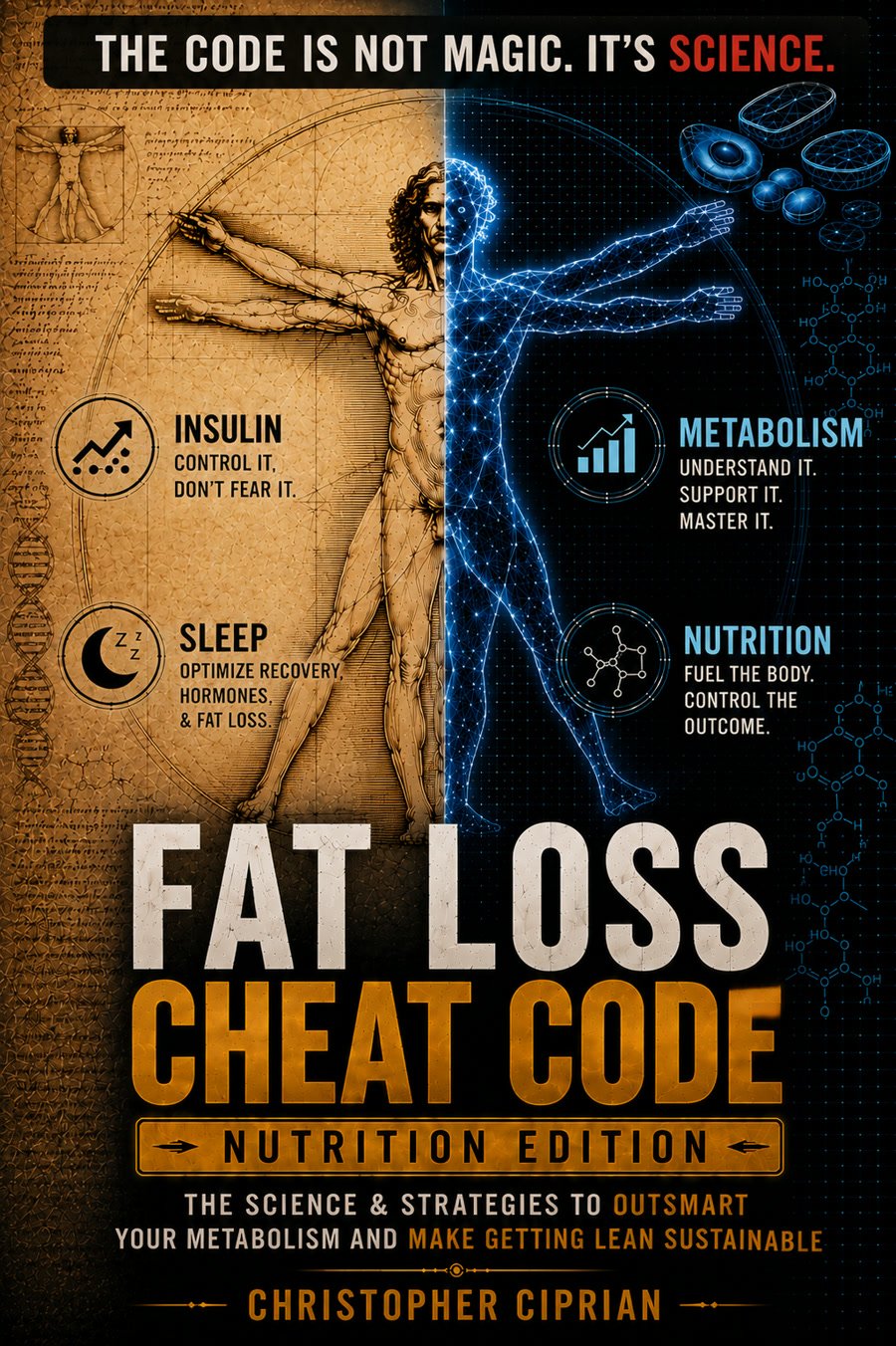
If you like how that reads, the whole system is in my book, Fat Loss Cheat Code. Fifteen chapters, every rule with the science behind it, how it works, and the mistakes most people make. Protein is chapter three.
Buy on AmazonAnd if you’d rather have someone work out your number with you and build the day around it, that’s what coaching is for.
Sources: Trommelen et al., Cell Reports Medicine, 2023 (25 g vs 100 g, 36 men); Simpson and Raubenheimer, Obesity Reviews, 2005 (the protein leverage hypothesis); Gosby et al., PLoS One, 2011 (22 adults, 15% to 10% protein); Weigle et al., American Journal of Clinical Nutrition, 2005 (19 adults, 15% to 30% protein); Ahn et al., Diabetes and Metabolism Journal, 2019 (20 adults, a protein and fiber bar 15 minutes before a meal); Moore et al., Journals of Gerontology Series A, 2015 (older vs younger men, protein per meal); Devries et al., Journal of Nutrition, 2018 (28 trials, 1,358 adults, kidney function); Westerterp, Nutrition and Metabolism, 2004 (thermic effect of food).