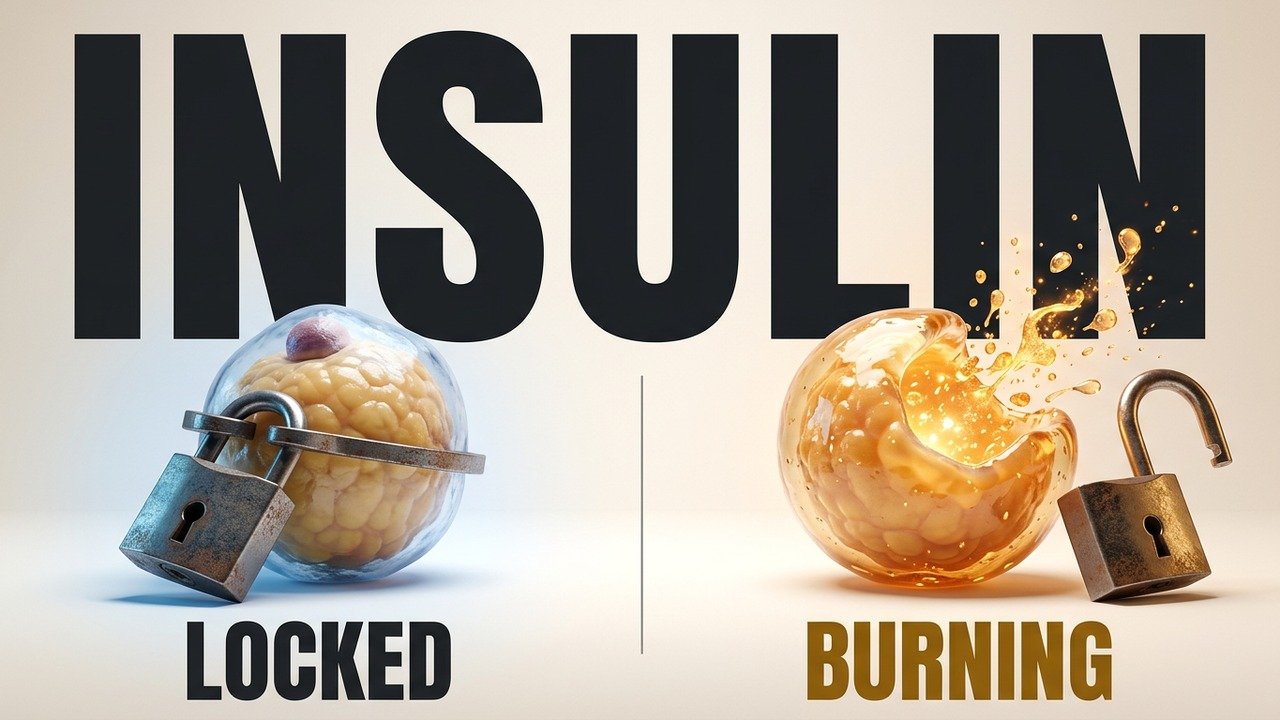
There’s a hormone that decides whether your body is even allowed to reach into your stored fat and burn it.
And most people keep it switched on almost all day long without ever knowing.
Here’s the honest version: you can do everything else right — decent food, reasonable portions, steps on the board — and still leave the fat parked, because of a habit so ordinary nobody counts it. A granola bar at ten. A sweetened latte at two. A few crackers at four.
So let’s go through it properly. First, what insulin actually does to your fat. Second, what insulin resistance is and why it’s a lot more common than you’d guess. Third, how to bring it down, including the one change I’ve seen move the needle more than any other.
What does insulin do to body fat?
Insulin is a hormone your pancreas makes when you eat, especially when you eat carbs.
Think of it as a doorman.
Sugar shows up in your bloodstream, and the doorman walks it into your muscles and your liver, where it gets stored as glycogen. That’s his job, and he’s good at it. But while he’s on shift, he does one other thing: he locks the exit door on your fat cells.
The technical word for fat leaving a fat cell is lipolysis. In plain English, that’s your fat cells releasing stored fat into your bloodstream so your body can actually burn it. While insulin is up, that door stays shut.
Now, insulin isn’t the villain here. You need it to live. The problem isn’t the doorman. It’s that the doorman never goes home.
And one thing I want to be straight about, because my book is clear on it: this isn’t a free pass. If you’re eating a lot more than you burn, it gets stored, no matter where those calories came from. Insulin decides how easily you can get at your fat. It doesn’t repeal arithmetic.
What happens when you lower insulin?
There’s a study out of Boston, published in JAMA, that gets at this nicely.
Researchers took 73 young adults with obesity and followed them for a year and a half. One group ate a low-fat diet. The other ate a diet built to keep insulin and blood sugar lower. Both groups included people who were running high insulin to begin with.
Across all 73 people, the two diets came out about even. That part matters, and you won’t hear it in most retellings.
But among the people who started with high insulin, the split was dramatic. On the lower-insulin diet they lost about 13 pounds. On the low-fat diet, just under 3.
Same length of study. Same effort. Four times the result, for the people whose insulin was the thing standing in the way.
So in plain English: the more you keep insulin under control, the more chances your body gets to actually use your fat stores during the day.
What is insulin resistance?
Normally the system is tidy. The doorman knocks, your cells open up, glucose goes in, the signal fades, and he clocks out.
But when your cells get hit with sugar and insulin all day, every day, they start tuning him out. He knocks. Nobody answers.
That’s insulin resistance.
So your body does the obvious thing: it sends more doormen. Your pancreas pumps out more and more insulin. It stays elevated longer. And that exit on your fat cells stays locked for a bigger slice of your day.
That’s when fat loss starts to feel like pushing a car uphill. You’re doing the work. The car is barely moving.
How common is insulin resistance?
Far more common than most people think, and it starts younger than you’d expect.
A study in the Journal of Clinical Endocrinology and Metabolism ran the numbers on 6,247 American adults aged 18 to 44 — none of them diabetic. In the most recent stretch of data, about 4 in 10 already had insulin resistance.
Four in ten. Under 45. No diabetes diagnosis. Most of them with no idea.
Here’s the part that should cheer you up, though. Insulin sensitivity responds to how you live. My book lists what drives it in the wrong direction: processed food, eating more than you burn, sitting all day, poor sleep, stress, and losing muscle. Every one of those is something you can change, and in my experience with clients, cells start answering the door again fairly quickly once you do.
How to lower insulin
Start with the plate, then fix the clock. The clock is the part almost nobody counts.
Build your meals around protein
Protein barely moves insulin compared to refined carbs, and it keeps you full, which quietly solves the snacking problem downstream. I’ve written up how much protein to actually aim for separately — the short version is that it should be the thing you build the meal around, not the garnish.
Pick carbs that still have their fiber
Beans, potatoes, berries, oats. The fiber slows the whole delivery down, so instead of a spike you get a gentler rise. Same carb, completely different demand on the doorman.
Cut back on the sugary drinks
Fruit juices, sports drinks, sweetened coffees. These are the worst offenders for insulin, because it’s pure sugar with none of the fiber that would have slowed it down. Liquid sugar arrives all at once.
Give the doorman a break
This is the big one, and it’s the one people never count.
Every single time you eat, insulin goes up. So if you’re grazing from breakfast to bedtime, insulin never comes back down. The doorman never clocks out, and the exit on your fat cells never opens.
Honestly, of everything on this list, cutting out the grazing is the change I’ve seen produce the biggest results with the people I’ve coached. Not a new diet. Not fewer calories. Just fewer occasions.
Does eating fewer, bigger meals help?
There’s a study in Diabetologia that tests this about as cleanly as you could ask for.
Researchers took 54 people with type 2 diabetes — so, people whose cells had already stopped answering the door — and gave them the exact same calories two different ways, for 12 weeks each. Six small meals a day, or two bigger ones.
On the two meals, they lost about 8 pounds. On the six, about 5. And their insulin sensitivity improved significantly more on the two-meal pattern.
Same food. Same calories. Just packed into fewer sittings.
Now, fair warning: those were people with type 2 diabetes, so it’s not a perfect stand-in for everybody. But it lines up exactly with what I say in my book — give yourself real gaps between meals. Because the gap is where the doorman clocks out, your body switches over, and it finally runs on the fat you’re carrying.
That’s the whole goal.
What can I eat between meals without spiking insulin?
If you genuinely need something in the gap, pick something that barely nudges insulin and doesn’t wake the doorman up. From what I give my clients:
- Coffee with milk or cream
- A little cheese
- A couple of hard-boiled eggs
- Nuts or seeds
- A beef stick
- Vegetables with hummus
What you’re cutting is the granola bars, the crackers, and the sweet stuff. Those are the ones that look innocent and clock the doorman back in.
Give the doorman a break
So here’s the one thing to do, starting today.
Structured meals, at least three hours apart, for the next seven days. Don’t change what you eat yet. Don’t cut anything. Just stop the grazing and give yourself real gaps.
You’ll likely notice two things in that first week: you get hungry at predictable times instead of constantly, and the hunger passes instead of building. That’s the system starting to work the way it’s supposed to.
Give the doorman a break, and let your body get to the fat.
If you want some of the cheat codes I use every day to get and stay lean, grab the 10 Fat Loss Commandments. It’s free, it’s ten rules, and each one comes with the reason behind it.
Send me the commandments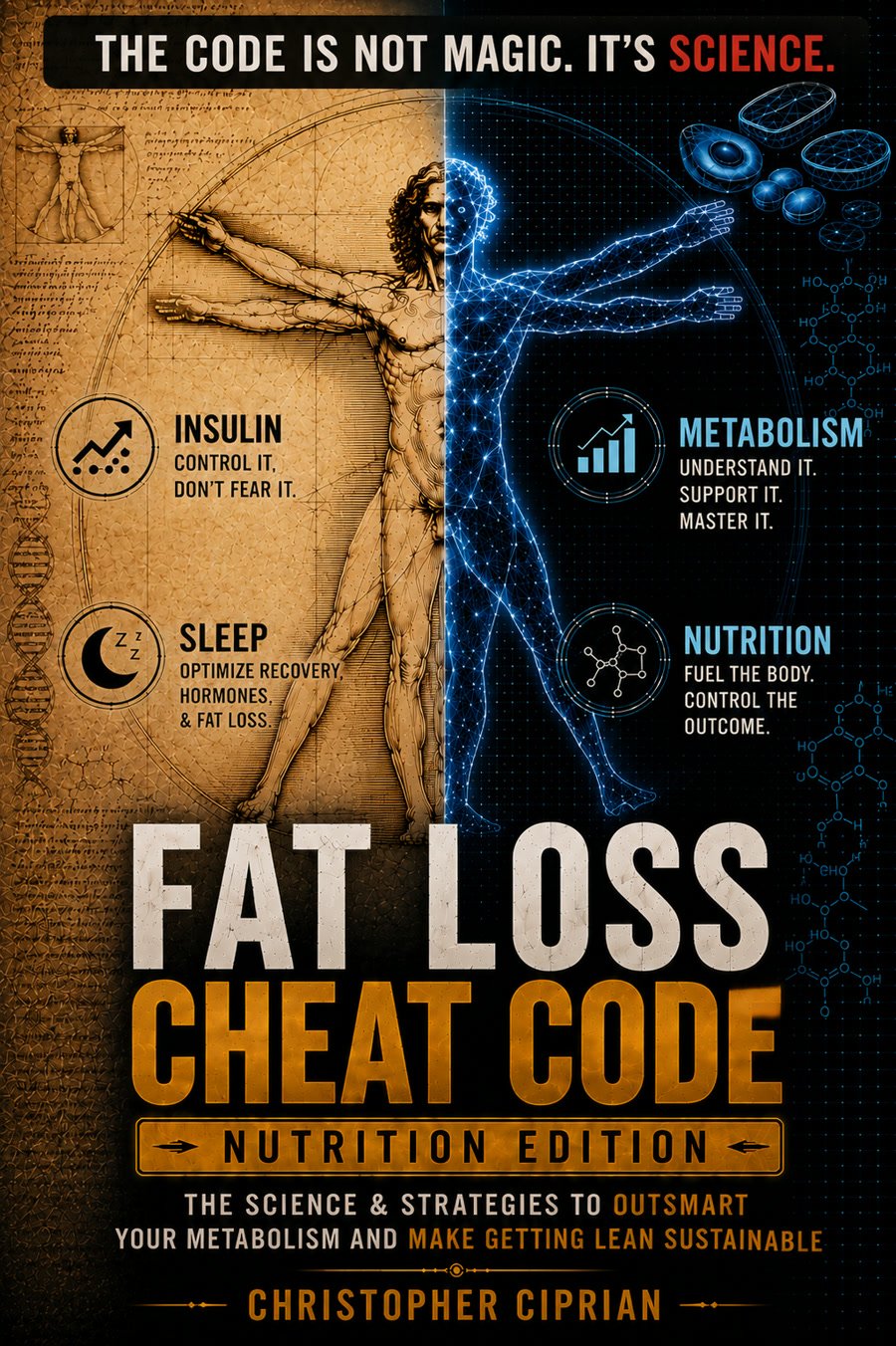
If you like how that reads, the whole system is in my book, Fat Loss Cheat Code — fifteen chapters on how to outsmart your metabolism, every rule with the science behind it, how it works, and the mistakes most people make. Insulin is chapter four.
Buy on AmazonAnd if you’d rather have someone build the meal structure around your actual schedule, that’s what coaching is for.
Sources: Ebbeling et al., JAMA, 2007 (73 adults aged 18 to 35 with obesity, 18 months, a lower-insulin diet against a low-fat diet; among those with above-median insulin secretion, −5.8 kg vs −1.2 kg); Parcha et al., Journal of Clinical Endocrinology & Metabolism, 2022 (6,247 US adults aged 18 to 44 without diabetes; insulin resistance in 44.8% in 2007–2010 and 40.3% in 2015–2018); Kahleova et al., Diabetologia, 2014 (54 people with type 2 diabetes, the same calories as two meals or six meals a day, 12 weeks each; −3.7 kg vs −2.3 kg).