Quick answer: more than you probably think. As we get older, our muscles get less efficient at using protein, so the target goes up with age. The method in my book is about 1 gram per pound of lean body mass, bumped up to about 1.4 grams at 50. Your number depends on your size and your body fat, so work out your own, and make most of it come from high-quality protein.
So here’s what usually happens. You hit your fifties, the weight starts creeping on, and you do what everybody tells you to do. You eat less. Smaller portions, skip a meal here and there, salads for lunch. And the scale moves a little, but you feel softer, weaker, and tired. That’s because when you eat less without enough protein, you don’t just lose fat. You lose muscle too. And muscle is the stuff that keeps your metabolism up and keeps you strong.
So here’s what we’ll cover. First, why your protein needs go up after 50. Second, how to work out your own number, step by step. And third, how to actually hit it without eating chicken breasts all day.
Why do you need more protein after 50?
There’s a name for it: anabolic resistance. What does that mean? It means your muscles get a little hard of hearing. The same amount of protein that sent a loud “build and repair” signal at 25 sends a quieter one at 55. So you need to turn the volume up.
There’s an analysis in the Journals of Gerontology that compared older men, around seventy, with young men, around twenty-two. To get the most muscle-building response out of one meal, the older men needed about two-thirds more protein for their body weight. Now, that was men, and a lot of the research on aging and protein is. But the direction is the same for everybody. Older muscles need more.
And it matters even more when you’re trying to lose weight, because a calorie deficit is exactly when your body is most willing to give up muscle. Protein is the signal that tells it to hold on.
How much protein should a woman over 50 eat to lose weight?
Here’s the method from my book, and it’s the same one in how much protein you need to lose weight. Start with about 1 gram of protein per pound of lean body mass. At 40, bump it to about 1.2 grams. At 50, about 1.4.
Lean body mass is everything in your body that isn’t fat: muscle, bones, organs, water. We use it instead of total weight because if you’re carrying extra fat, a number based on total weight can end up way too high.
Here’s how the math works, step by step:
- Estimate your body fat. A smart scale, a DEXA scan, or a good estimate from photos. It doesn’t have to be perfect.
- Find your lean body mass. Your weight minus the fat.
- Multiply by your age factor. About 1.4 at 50.
So, just as an example: say a woman weighs 140 pounds at about 30 percent body fat. Thirty percent of 140 is 42 pounds of fat, so her lean body mass is about 98 pounds. Times 1.4, that’s somewhere around 135 to 140 grams a day. That’s her example, not your number. Someone at 180 pounds and 40 percent body fat lands somewhere different, and so do you. Okay?
And there’s a reason my book says to build in a little breathing room. Food labels can legally be off by as much as 20 percent. So if you aim right at the bare minimum, you might be coming up short without knowing it.
Does the kind of protein matter?
It does, and even more so when you’re eating less. In my book I use something called DIAAS, which stands for the Digestible Indispensable Amino Acid Score. That’s a mouthful, so here’s what it means: it scores a protein on two things, whether it has all the building blocks your muscles need, and how much of it your body can actually digest and use.
Two foods can have the same grams on the label and very different scores. Whey, milk protein, eggs, beef, chicken and fish all score high. Soy does pretty well. Pea protein is decent. Wheat protein is low.
Why does that matter over 50? Because when calories are tight, every bite has to pull its weight. You don’t have room to spend a bunch of calories on protein your body can only partly use.
If you’re plant-based, you can absolutely do this. You just need bigger portions of some plant proteins to get the same usable protein, and those portions bring extra carbs and calories with them. My book’s suggestion is to add essential amino acids, EAAs for short, to fill in what’s missing.
How to actually hit your protein without living on chicken
This is where most people give up, so let’s make it easy:
- Front-load it. Make your first meal the most protein-heavy meal of the day, a big portion of your daily target, up to about half. I’ve got a whole list in high protein breakfast ideas.
- Protein first, every meal. Build the plate around the protein, then add the rest.
- Use the easy ones. Greek yogurt, cottage cheese, eggs, a scoop of protein powder in a shake.
- A shake before your first meal. In my book this is the easiest head start there is: a protein shake about fifteen minutes before you eat.
And lift something. Protein is the building material, but resistance training is the work order. You need both to hold on to muscle while the fat comes off.
It’s not too late
I’ll tell you a little bit about me. After a back injury put me out of commission, I went up to 217 pounds, completely de-trained, and lost most of my muscle. Then, in one year, using the same techniques in my book, I got down to 165 with single-digit body fat. In my forties. Your body still responds. It just needs a louder signal.
The one thing to do this week
Work out your number, using the three steps above. Then track your protein for three days, without changing anything, and see how close you are. Most people are surprised.
If you want more cheat codes like this sent straight to your inbox, sign up here. It’s completely free, and just for signing up, I’ll also send you my guide, the 10 Fat Loss Commandments.
Send me the commandments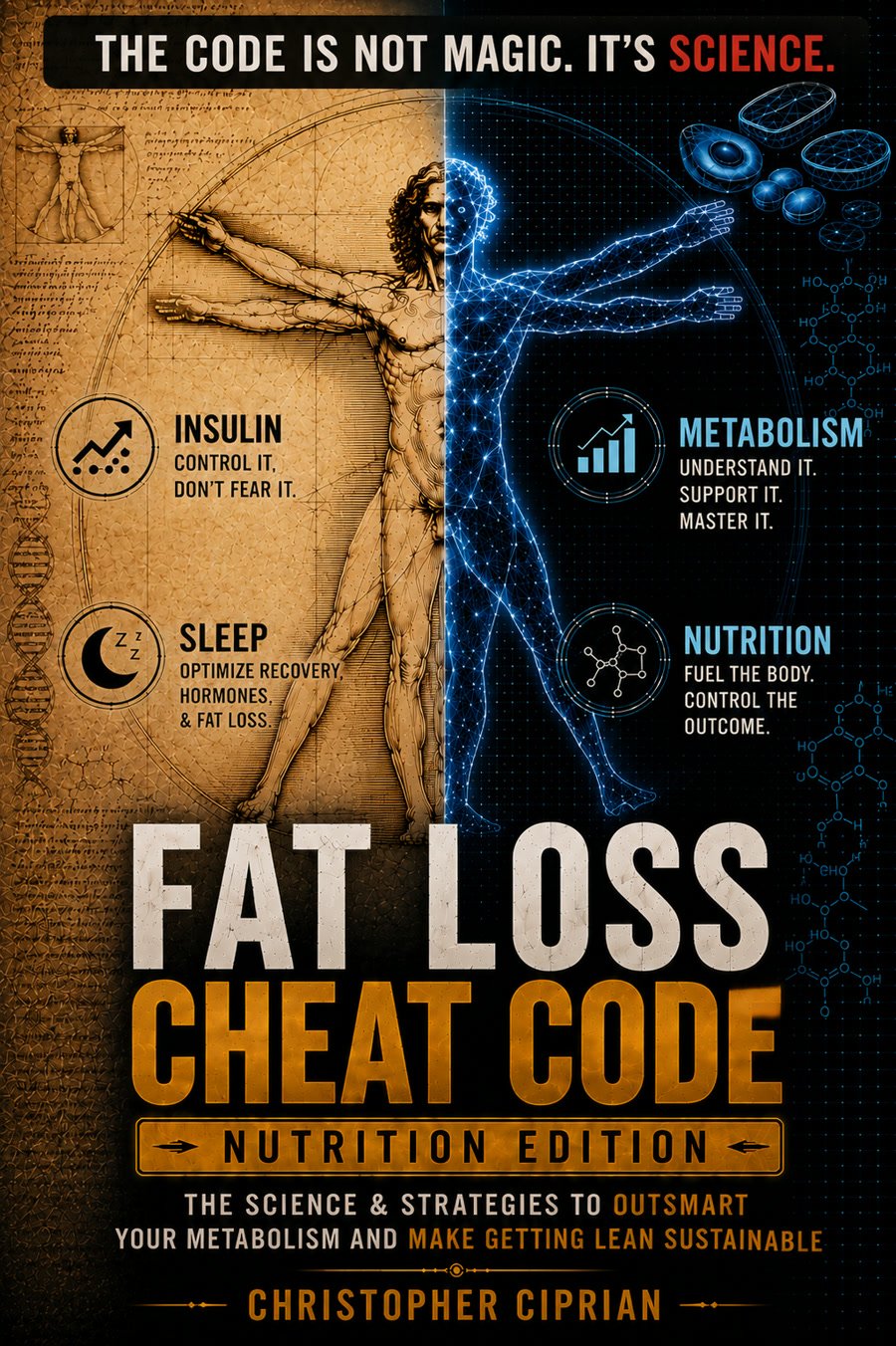
The whole system is in my book, Fat Loss Cheat Code: Nutrition Edition. It’s how you outsmart your metabolism, with every cheat code and the science behind it. Protein is chapter three.
Buy on AmazonAnd if you’d rather have someone work out your number with you and build your meals around it, that’s what coaching is for.
Sources: Moore et al., Journals of Gerontology Series A, 2015 (older vs younger men, protein per meal).