
Quick answer: if you think you have a slow metabolism, check your thyroid before you cut calories again. Your thyroid sets how fast your cells burn energy, about one in twenty Americans has a low one, and many don’t know. Ask your doctor for a full thyroid panel (TSH, free T4 and free T3), and make sure you’re getting enough iodine and selenium.
“I just have a slow metabolism.” I hear it all the time. And usually it comes right before somebody cuts their calories even lower, adds another cardio class, and feels worse a month later with nothing to show for it.
Sometimes your metabolism really is running slow. But the question is why. And one of the most common reasons is a little gland in your neck that most people never think to check.
Here’s the plan. First, what your thyroid does and the warning signs it’s running low. Second, the blood tests that tell you for sure. Third, what your thyroid needs from your food.
What does your thyroid have to do with your metabolism?
Your thyroid is a little butterfly-shaped gland in your neck, and in my book, Fat Loss Cheat Code, which is all about how to outsmart your metabolism, I call it your metabolic thermostat.
Here’s why. It works like the thermostat in your house. It sets how fast your cells burn energy. When it’s running right, the furnace kicks on like it should. When it slows down, it’s like someone turned the dial from 72 down to 65. The house still runs, it just burns a lot less fuel.
That means you can be doing everything right on your end, eating clean, training, getting your steps in, and still not see it on the scale. Your effort isn’t the problem. The heat is turned down.
What are the signs of a slow thyroid?
Some common warning signs:
- Feeling tired all the time
- Always being cold when everyone else is fine
- Weight gain you can’t explain
- Dry skin
- Constipation
- Struggling to lose fat even when you’re eating clean
One or two of these on their own can mean lots of things. A few together, plus a scale that won’t move, is a good reason to get checked.
How common is a low thyroid?
More common than you’d think. A national study in the Journal of Clinical Endocrinology and Metabolism tested the blood of over 17,000 Americans. About one in twenty had a low thyroid. Most of those cases were mild, and a big part of the people with lab signs of thyroid trouble had no idea.
Think about that. One in twenty, and a lot of them would never know without a blood test. Mild doesn’t mean it doesn’t matter, either. A thermostat that’s only a few degrees low still burns less fuel every single day.
What thyroid tests should you ask for?
Ask your doctor for a full thyroid panel, not just one number. Here’s what’s in it:
- TSH: the signal your brain sends telling your thyroid to work. It’s often the only number that gets checked.
- Free T4: the stored form of your thyroid hormone.
- Free T3: the active form, the one your cells actually use.
Why all three? Because TSH tells you how hard your brain is pushing, but not how much active hormone is actually reaching your cells. Free T4 and free T3 fill in the rest of the picture. Then you’ll know if your thermostat is set right.
I’m a nutrition consultant, not a medical doctor, so let your doctor read the results with you. And don’t chase a perfect score on every number. The point of testing is to find what might be working against you. The rest of the panel worth asking for is in blood tests for weight loss.
What does your thyroid need from your food?
Your thyroid needs the right raw materials. It’s not just the gland, it’s what you’re feeding it.
Iodine is what it builds its hormone from. Where to find it:
- Seaweed, the richest natural source
- Iodized salt
- Seafood
- Dairy
Selenium helps turn the stored hormone (T4) into the active one (T3). Where to find it:
- Brazil nuts
- Seafood
- Organ meats
One caveat, straight from the book: balance matters. Too little iodine is a problem, but so is taking way too much in supplements. Both can get in the way of your thyroid. Food first, and talk to your doctor before you start supplementing.
What if your thyroid is fine?
Then you’ve ruled out the thermostat, and that’s good news. A metabolism can also slow down after long stretches of hard dieting. It’s not broken, and you can bring it back. I explain how in can metabolic damage be fixed. And for the full list of what else to check, read why you can’t lose weight.
The one thing to do this week
Before you cut another calorie, look at that list of warning signs. If a few of them sound like you, call your doctor and ask for a full thyroid panel: TSH, free T4 and free T3. Know your thermostat setting before you start fighting it.
Keep reading
- Why you can’t lose weight (even with clean eating and exercise)
- How to lose weight after 40: why fat moves to your belly
- Blood tests for weight loss: the 4 things to ask your doctor for
If you want more cheat codes like this sent straight to your inbox, sign up here. It’s completely free, and just for signing up, I’ll also send you my guide, the 10 Fat Loss Commandments.
Send me the commandments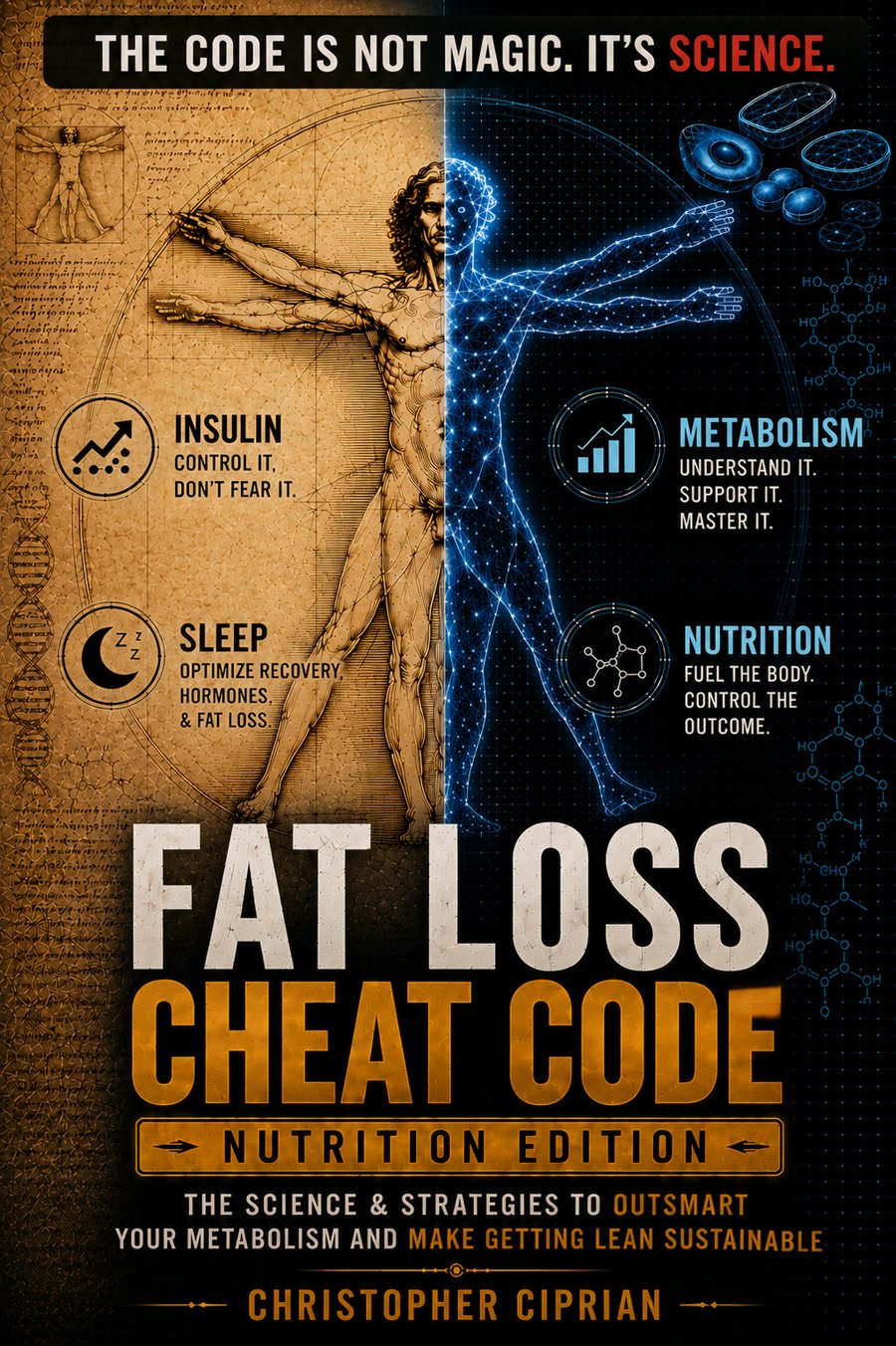
The whole system is in my book, Fat Loss Cheat Code: Nutrition Edition. It’s how you outsmart your metabolism, with every cheat code and the science behind it. The thyroid is in chapter one.
Buy on AmazonAnd if you want someone to look at your whole picture with you and adjust as you go, that’s what coaching is for.
Sources: Hollowell et al., Journal of Clinical Endocrinology & Metabolism, 2002 (17,353 people, NHANES III).