
Quick answer: autophagy is your body’s recycling crew: your cells break down old, worn-out parts and reuse them. Fasting is one of the strongest ways to turn it up. The first signs in people show up after about an eighteen-hour overnight fast, and in one six-month study a fasting plan raised autophagy while plain calorie cutting didn’t.
If you’ve spent any time on health YouTube, you’ve heard it. Autophagy. Usually right before someone tells you to fast for three days to “unlock” it.
Here’s the good news. You don’t need anything that extreme. Let me show you what autophagy actually is, what the human studies found, and how long you really need to go.
First, what autophagy does. Second, how long you have to fast. Third, whether cutting calories gets you the same thing, and how to set up your days so it happens without white-knuckling it.
What is autophagy?
It’s your body’s recycling crew. The word literally means “self-eating,” which sounds scarier than it is. Your cells break down old, worn-out parts and reuse the pieces.
Think of it like a mechanic who finally gets the car in the shop. While it’s driving around, nobody has time to work on it. Once it’s parked, the mechanic can pull out the worn parts and swap in good ones.
Food coming in all day keeps the car on the road. A fast parks it. That’s why fasting, along with cutting calories, is one of the strongest everyday triggers for autophagy we know of.
How long do you have to fast for autophagy?
Here’s what the human studies show.
The eighteen-hour overnight fast. In one study, adults ate only between eight in the morning and two in the afternoon for four days. That’s about an eighteen-hour fast overnight. The next morning, an autophagy gene in their blood was more active than when they ate from eight to eight.
So the first signal in people showed up after about eighteen hours. In the seven stages of fasting, that’s stage four, sixteen to twenty hours, the same stretch where you’re burning your own fat. (Here’s the whole hour-by-hour breakdown.)
Six months of fasting. In a bigger study, a hundred and twenty-one adults followed a fasting plan for six months. Their autophagy went up. That’s the longest look we have at it in people, and it points the same way: regular fasting turns the recycling crew up.
Can you get autophagy from cutting calories?
That same six-month study had a group that just cut calories, no fasting. And check this out: their autophagy didn’t go up.
Both groups cut back. Only the fasting group unlocked the cellular cleanup. The mechanic needs the car parked, not just driven a little less.
That’s one of the reasons I like fasting as a tool even when the calories are already handled. It isn’t only about eating less. Giving your body real stretches with no food coming in is what lets it get to the maintenance work, and it’s also how you practice switching between fuels, which is what metabolic flexibility is all about.
Do you need a 3-day fast for autophagy?
No. The human signal showed up after an overnight fast of about eighteen hours. And for fat loss, longer isn’t better past a point: after about thirty-six hours the fat-loss payoff starts dropping and the risk of losing muscle goes up. If you’re curious what the full day looks like, here’s what happens when you fast for 24 hours.
How do you set up your fast for autophagy?
Keep it simple and repeatable:
- Start at twelve hours. Close the kitchen after dinner, seven p.m. to seven a.m. Don’t jump straight to eighteen.
- Stretch toward sixteen to eighteen. Once twelve feels easy, push one day, then a few days a week.
- Try eating earlier. The eighteen-hour study had people eat from eight to two. In my book I call this early time-restricted feeding: move your eating window earlier, because your body handles food better earlier in the day. Finish early, and the overnight fast stretches on its own.
- Keep lifting, and put protein in your first meal. The point is to clean house, not to tear down muscle.
- Add a pinch of salt to water if you get foggy or a headache in the later hours.
The one thing to do this week
Pick two days and finish your last meal by early afternoon or early evening, then don’t eat again until the next morning. Aim for sixteen hours the first day and eighteen the second, and see how you feel.
Keep reading
- What happens to your body when you fast, hour by hour (7 stages)
- What happens when you fast for 24 hours?
- Intermittent fasting for weight loss: where to start (and where to stop)
If you want more cheat codes like this sent straight to your inbox, sign up here. It’s completely free, and just for signing up, I’ll also send you my guide, the 10 Fat Loss Commandments.
Send me the commandments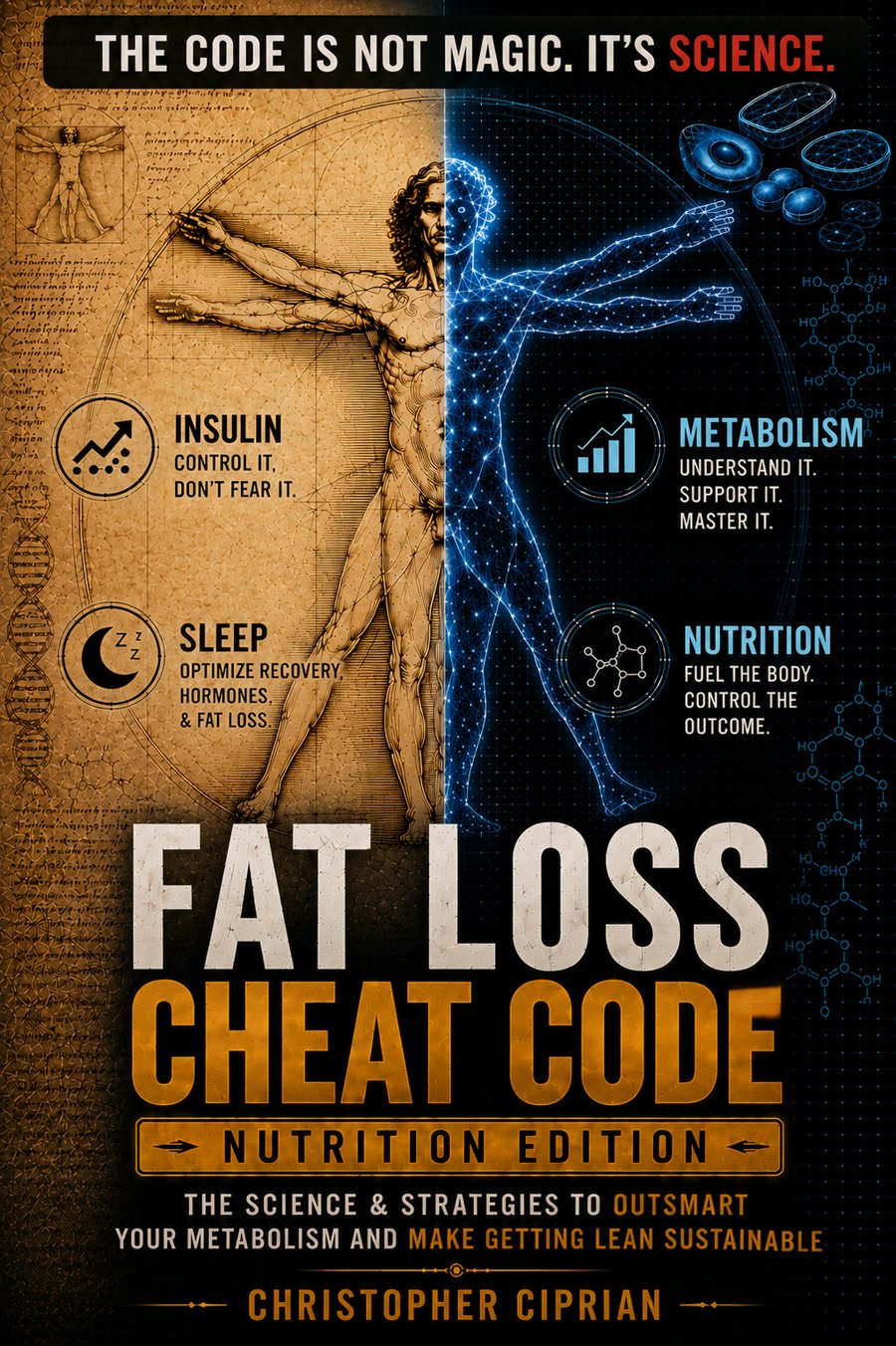
The whole system is in my book, Fat Loss Cheat Code: Nutrition Edition. It’s how you outsmart your metabolism, with every cheat code and the science behind it. Fasting, including early time-restricted feeding, is chapter eight.
Buy on AmazonAnd if you want help building a fasting window that fits your days and your training, that’s what coaching is for.
Sources: Jamshed et al., Nutrients, 2019 (11 adults with overweight, eating 8 a.m.-2 p.m. vs 8 a.m.-8 p.m., 4 days each). Bensalem et al., Journal of Physiology, 2025 (121 adults with obesity, 6 months; intermittent fasting vs calorie restriction).