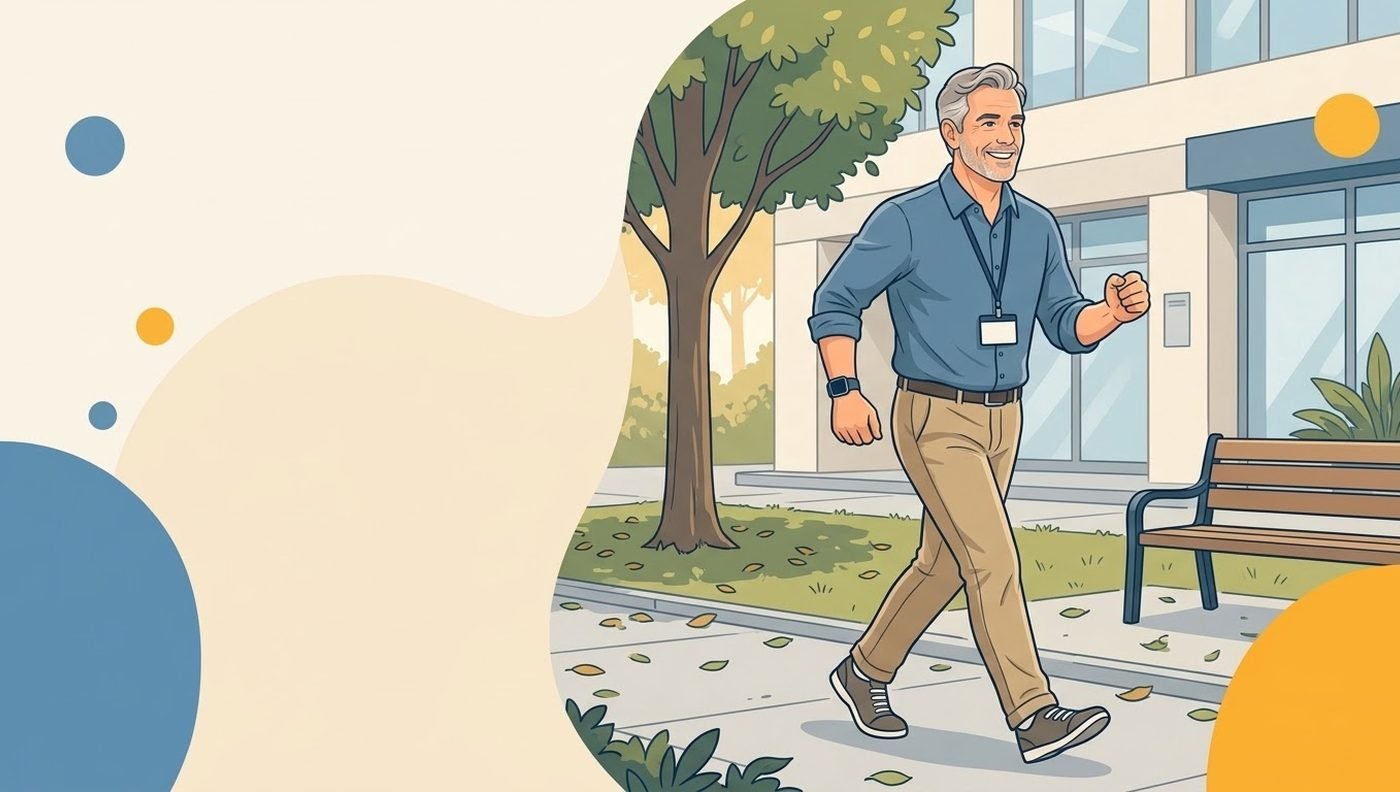
Quick answer: yes, walking is one of the best tools for fat loss, and how you walk matters more than how far. At an easy pace your body burns mostly fat, and because walking needs no recovery, you can do it several times a day. In one study, a 1 minute 40 second walk every half hour lowered blood sugar and insulin more than one 30-minute walk did.
Here’s a day a lot of people know. Alarm at 5:30, a hard workout, a protein shake, a shower. Then eight, nine, ten hours in a chair. Then the couch.
That workout counts. But the ten hours of sitting count too, and they’re winning. Walking may just be the king of fat loss, and it was one of the six things I changed to go from 217 to 155 pounds. (The full list: how I lost 60 pounds in under a year.)
First, why walking burns fat so well. Second, why several short walks beat one long one. Third, what sitting all day really costs, and how to fix it without quitting your job.
Does walking burn fat?
Yes. At an easy pace, your fat stores supply most of the fuel. The harder you push, the more your body switches over to carbs. That was shown back in 1993: at the lowest effort, fat released from fat stores was at its highest, and carbs took over as the pace went up.
To be fair, there’s a nuance. A later study found the total fat burned per minute peaks at a moderate pace, not the slowest one. For most people that’s a brisk walk, which is right where you want to be anyway.
And walking on its own moves the scale. A review of thirty-two trials found that walking alone, with no other changes, took off about three pounds and about one percent body fat. In adults with obesity, a review of twenty-two trials found brisk walking took off about five and a half pounds of fat.
That’s not dramatic. But walking has an advantage running and HIIT don’t: it’s easy on your joints, it needs no equipment, and it takes zero recovery time. So you can do it more than once a day. Which is exactly the point.
Is it better to walk once a day or several times?
Several times. When it comes to movement, frequency beats volume.
It’s better to move all through the day than to crush one session and then sit still for eight hours. Even if all those little bits of movement add up to less total time, they keep your body from sliding into that stalled, sedentary state. Five short walks that add up to eight thousand steps beat one big ten-thousand-step walk in the morning.
The study: researchers in New Zealand had seventy adults come in for three separate days of sitting for nine hours.
- Day one: they just sat.
- Day two: they walked for thirty minutes first, then sat.
- Day three: they got up every half hour and walked for one minute and forty seconds. That adds up to the same thirty minutes.
The short breaks lowered blood sugar and insulin more than the one long walk. In fact, the one long walk barely changed their blood sugar at all compared to just sitting. (To be fair, the long walk did lower blood fats, called triglycerides, a bit more. Both are worth doing.)
Here’s why. Every time your muscles contract, they open little gates in your cells that pull sugar straight out of your blood, without needing insulin. As I put it in my book, gentle, repeated muscle contractions let your muscles vacuum glucose straight out of your bloodstream. Sit for hours and those gates stay shut. Get up every half hour and they keep opening. (Why that matters so much for fat loss: how to lower insulin naturally.)
Is sitting as bad as smoking?
It’s in the same league. Researchers estimated that physical inactivity causes about five point three million deaths a year worldwide, on par with smoking.
And in a study of over a million people, the ones who sat more than eight hours a day and barely moved had a fifty-nine percent higher risk of dying. Here’s the good news buried in that same study: the people who moved about an hour a day, even with a desk job, wiped that extra risk out.
There’s a fat-loss cost, too. In one study, people with obesity sat about two hours a day longer than lean people. If they moved like the lean group did, they’d burn about three hundred and fifty more calories a day, without a single workout.
How do you walk for weight loss?
Split it up. Instead of clustering all your activity into one block, spread five or six 10-minute movement breaks through the day.
In my book, Fat Loss Cheat Code: Nutrition Edition, which is all about how to outsmart your metabolism, the best time for one of those breaks has a name: THE MOVEMENT CHEAT CODE. Take a 10-minute movement break after your meals. Don’t go straight to the couch. You aren’t trying to burn the meal off. You’re giving your muscles a chance to help handle it. Eat. Move. Repeat.
Easy ways to fit the rest in:
- A walk after every meal, even ten minutes around the block.
- Walk your phone calls. Any call that doesn’t need a screen.
- A two-minute lap every half hour at work. Set a timer if you have to.
- No time to walk? Do a round of air squats, push-ups or calf raises.
- Stuck in a chair or the car? Squeeze a hand grip strengthener. It’s not a walk, but it’s not nothing.
And if you lift too, keep doing it: walking and lifting do different jobs. (More on that: lifting weights fasted: does it burn muscle?)
The one thing to do this week
Take a 10-minute walk after your biggest meal every day for seven days. Then add one more short walk somewhere else in your day.
Keep reading
- How I lost 60 pounds in under a year (the exact methods)
- Lifting weights fasted: does it burn muscle?
- Early time-restricted eating: why I stopped eating after dark
If you want more cheat codes like this sent straight to your inbox, sign up here. It’s completely free, and just for signing up, I’ll also send you my guide, the 10 Fat Loss Commandments.
Send me the commandments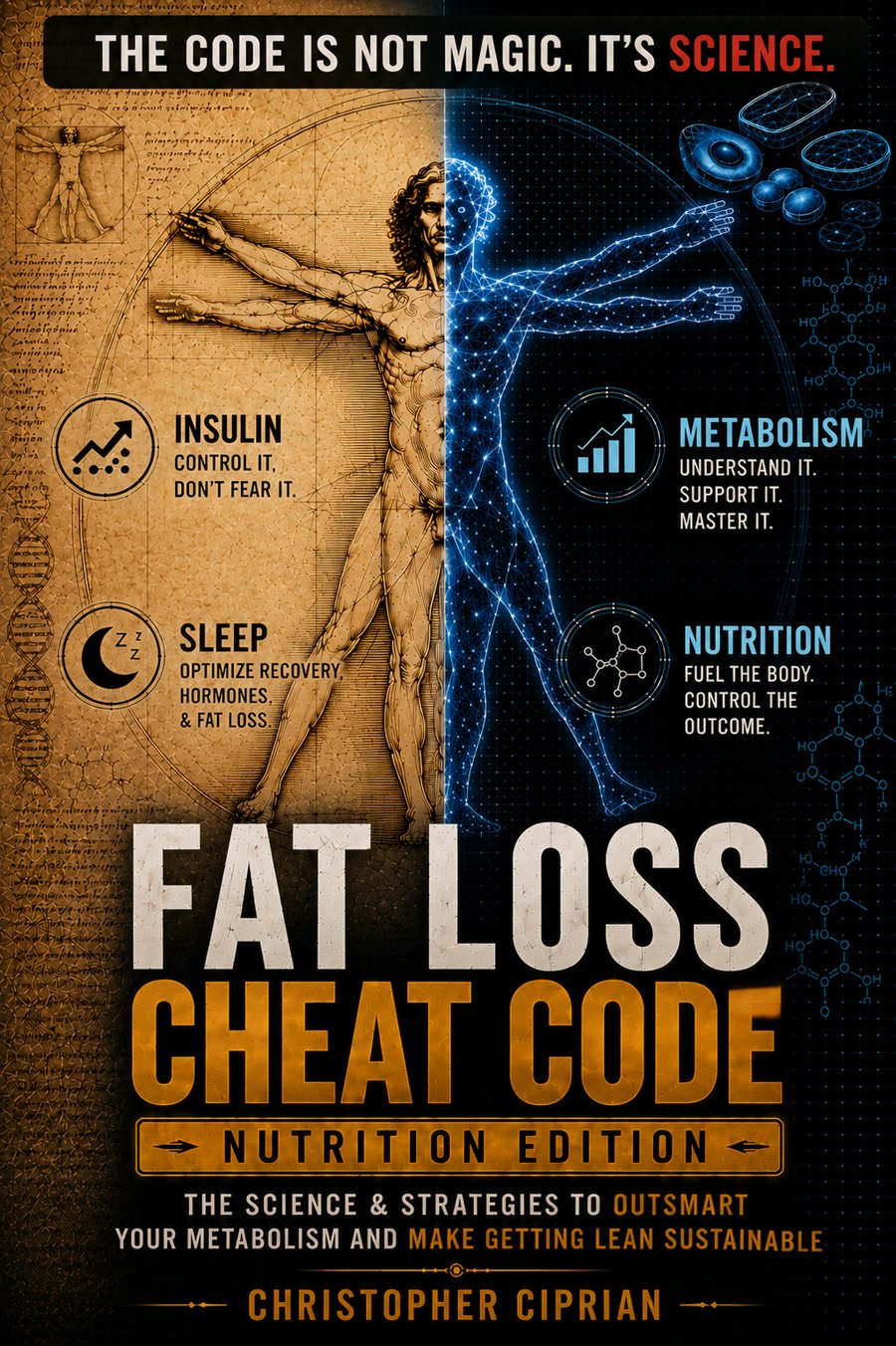
The whole system is in my book, Fat Loss Cheat Code: Nutrition Edition. It’s how you outsmart your metabolism, with every cheat code and the science behind it. Everyday movement, and the Movement cheat code, are in chapter fourteen.
Buy on AmazonAnd if you want someone to fit movement into the day you actually have, that’s what coaching is for.
Sources: Romijn et al., American Journal of Physiology, 1993 (fuel use by exercise intensity). Achten and Jeukendrup, International Journal of Sports Medicine, 2003 (55 trained men, peak fat burning). Murtagh et al., Preventive Medicine, 2015 (32 trials, walking only). Mabire et al., Journal of Physical Activity and Health, 2017 (22 trials, brisk walking in adults with obesity). Peddie et al., American Journal of Clinical Nutrition, 2013 (70 adults, walking breaks vs one walk). Lee et al., The Lancet, 2012 (physical inactivity worldwide). Ekelund et al., The Lancet, 2016 (over 1 million people, sitting time and activity). Levine et al., Science, 2005 (sitting time in lean people and people with obesity).