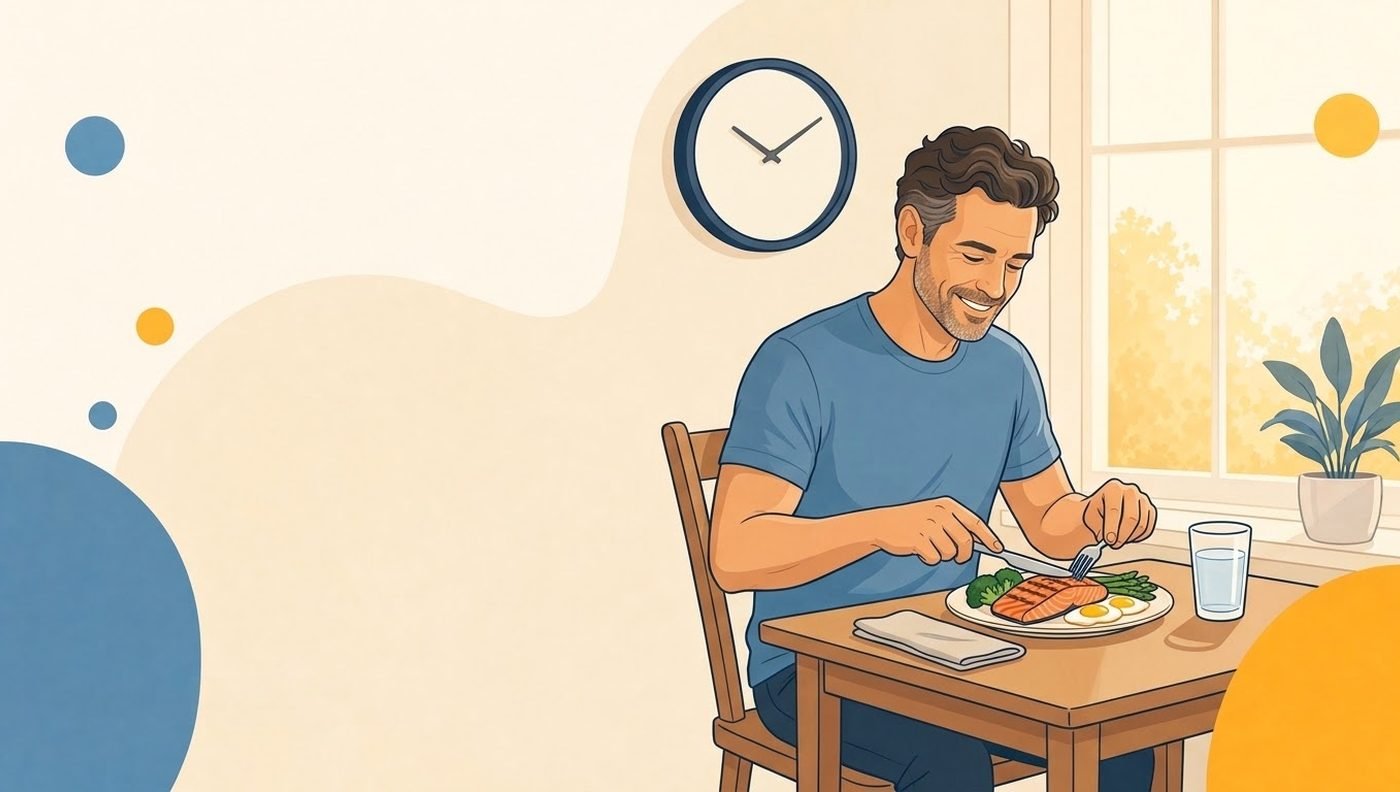
Quick answer: early time-restricted eating means fitting your meals into a window that ends early in the day, say 7 a.m. to 3 p.m., instead of noon to 8 p.m. Your body handles blood sugar best earlier in the day, so the same food eaten earlier burns more fat and leaves you less hungry. The simple version: if it’s dark out, don’t eat.
Here’s a common one. You’re doing 16:8, you’re proud of it, and your window runs from noon to eight at night. The fast is happening, technically. It’s just happening while you’re asleep, and all your eating is piled into the evening.
That’s how I was doing it too, until I moved the window. Moving it earlier is the timing change that broke my plateaus, and it costs nothing. It’s the second of the six things I changed to go from 217 to 155 pounds (the full list: how I lost 60 pounds in under a year).
First, what early time-restricted eating is and how it’s different from regular intermittent fasting. Second, why eating at night works against you, and what the studies found. Third, how to set your own window, and what to do when you’re “hungry” at 9 p.m.
What is early time-restricted eating?
It’s intermittent fasting with the window moved to the front of the day. With regular 16:8, you fast sixteen hours and eat in eight, and it doesn’t matter much which eight. With early time-restricted eating (you’ll also see it called early time-restricted feeding, or eTRF), the window ends early, often by mid-afternoon.
As I put it in my book, the key isn’t only how many hours you fast. It’s when those hours happen, and how closely your eating lines up with your body’s natural rhythm. The book’s example is eating between 7 a.m. and 3 p.m., then fasting through the afternoon, the evening and the night.
Is it better to eat earlier in the day?
For fat loss, yes. Your body runs on a clock. Earlier in the day it’s set up to handle food: your insulin sensitivity and your blood sugar control are at their best. As the day goes on, both slide.
The study: scientists fed eleven adults with overweight the exact same food for four days, two ways. Once between eight in the morning and two in the afternoon, and once stretched out from eight in the morning to eight at night. When they ate early, they burned more fat, their hunger hormone (ghrelin) dropped, and their hunger evened out across the day instead of building up at night. Same food. Just earlier.
A second one: in a five-week study, eight men with prediabetes finished eating by three in the afternoon. Their weight didn’t change, but their insulin sensitivity and blood pressure got better, and their appetite in the evening went down. Small study, but notice what happened: the body handled food better before a single pound came off.
Think of it like a diner with closing time. During the day the grill is hot and the staff is ready. Show up at 10 p.m. and the kitchen is half shut down: the food still gets made, just slower and sloppier. Your body processes a late meal, it just doesn’t handle it as well.
Why shouldn’t you eat after dark?
Because once the sun goes down your body starts winding down for sleep, and melatonin, your sleep hormone, kicks in. Melatonin and food don’t mix well.
In a study of 845 adults in Spain, people drank the same sugar drink either four hours before bedtime or one hour before. Close to bedtime, their melatonin was about three and a half times higher, and their blood sugar ran higher too. Same drink. Worse result, just because of the hour.
That’s why my rule is simple: if it’s dark out, the kitchen’s closed. Mine closes at six-thirty.
And if you’re stuck on a stubborn plateau, try finishing your last meal by one in the afternoon every now and then. It gives your digestion a real break, it takes care of next-day bloating, and in my experience the scale usually moves the next morning.
How do you start early time-restricted eating?
You don’t have to jump straight to a 7-to-3 window. Walk it back.
- Pick your cut-off. Sundown is the easy one to remember. If that’s too much at first, start with “nothing after dinner”.
- Move it earlier by half an hour every few days. If your window ends at 8 p.m. now, go to 7:30, then 7.
- Eat a real first meal. An earlier window only works if you’re not starving by 4 p.m. Build your first meal around protein and fat. (Ideas: high protein breakfast for weight loss.)
- Keep the same hours on weekends. Your body clock doesn’t know it’s Saturday. (More on that in social jetlag.)
- Stop grazing inside the window. Two or three real meals, not a snack every hour.
That last one has a name in my book, Fat Loss Cheat Code: Nutrition Edition, which is all about how to outsmart your metabolism. It’s THE ANTI-GRAZING CHEAT CODE: create clear breaks between your meals and stop treating every small bite as insignificant. Every time you eat, especially carbs, insulin goes up. Breaks between meals give it time to come back down.
What do you do when you’re hungry at night?
Most night hunger isn’t hunger. It’s situational: the couch, the TV, the pantry ten feet away. Or you’re a little dehydrated, or short on minerals.
Before you reach for a snack, try a tall glass of water with electrolytes, a squeeze of lemon or a pinch of sea salt. A lot of the time, that’s all your body wanted. If you’re truly hungry every night, that’s a sign your earlier meals need more protein, not that you need a 9 p.m. snack.
Who should be careful: if you take medication for blood sugar or blood pressure, talk to your doctor before you change when you eat, since both can shift as your eating window moves.
The one thing to do this week
Pick a cut-off time, sundown or 7 p.m., and keep it for seven days straight, weekends included. After that, notice two things: how you sleep, and how hungry you are in the morning.
Keep reading
- How I lost 60 pounds in under a year (the exact methods)
- Intermittent fasting for weight loss: where to start (and where to stop)
- Lifting weights fasted: does it burn muscle?
If you want more cheat codes like this sent straight to your inbox, sign up here. It’s completely free, and just for signing up, I’ll also send you my guide, the 10 Fat Loss Commandments.
Send me the commandments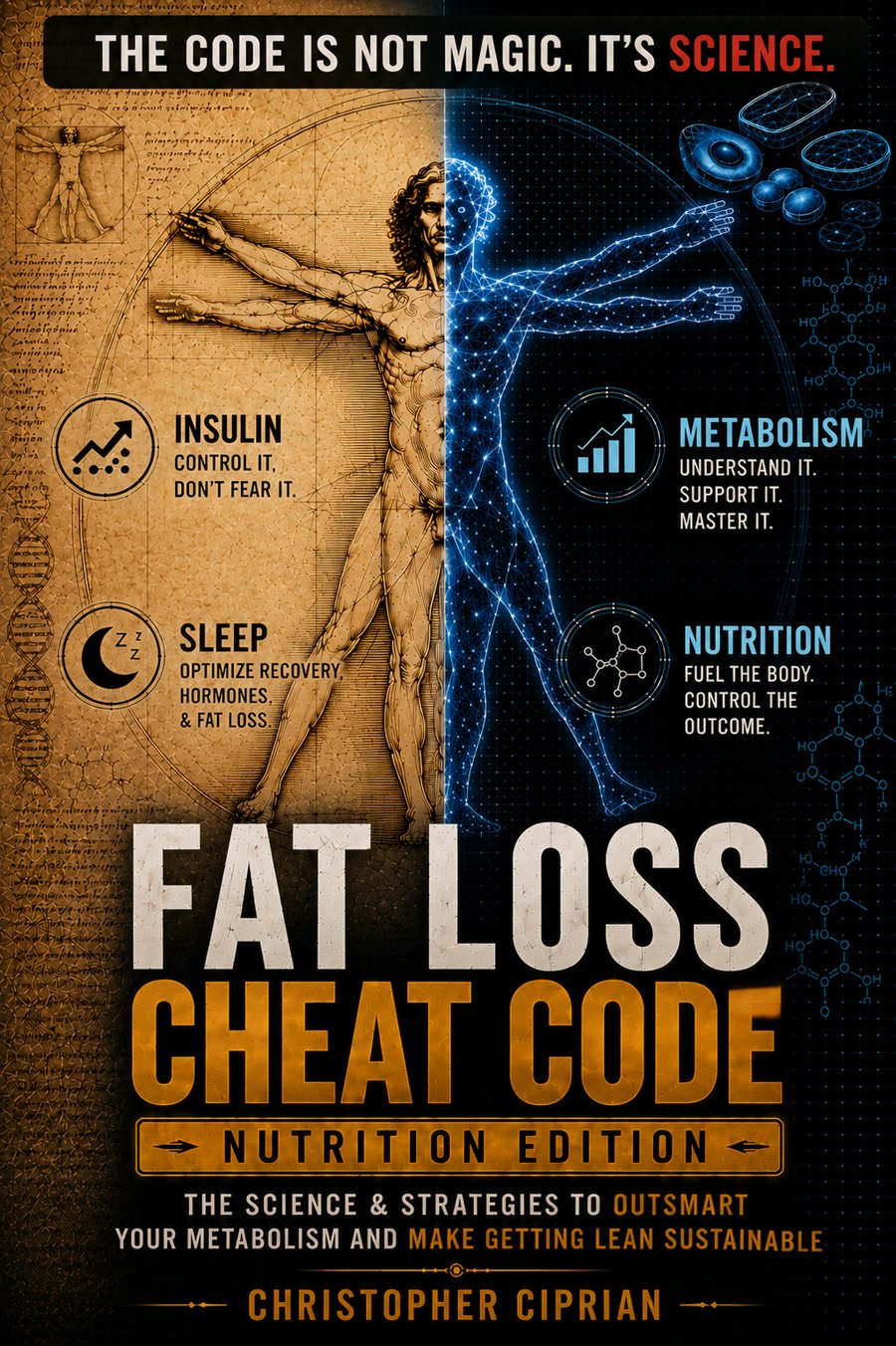
The whole system is in my book, Fat Loss Cheat Code: Nutrition Edition. It’s how you outsmart your metabolism, with every cheat code and the science behind it. Early time-restricted feeding is in chapter eight, and the Anti-Grazing cheat code is in chapter ten.
Buy on AmazonAnd if you want someone to set your eating window around your work, your training and your family dinners, that’s what coaching is for.
Sources: Ravussin et al., Obesity, 2019 (11 adults with overweight, early time-restricted feeding vs a 12-hour window). Sutton et al., Cell Metabolism, 2018 (8 men with prediabetes, eating done by 3 p.m., 5 weeks). Garaulet et al., Diabetes Care, 2022 (845 adults, the same glucose drink 1 vs 4 hours before bedtime).