Quick answer: yes, sleep affects weight loss, a lot. Calories decide how much weight you lose, but sleep helps decide what that weight is: fat or muscle. In one study, the same diet with short sleep cut the fat people lost by 55%. Short sleep also turns up your hunger hormones, and sleeping in on weekends throws your body clock off.
Most people treat sleep like an afterthought. They weigh their food, track every calorie, get up at five, hit the gym, all on five or six hours of sleep. Then on the weekend they stay up late and sleep in to catch up. They figure as long as the calories are right, the rest will follow.
But calories in, calories out only gives you part of the equation. It doesn’t tell you what your body does with those calories. And a big part of that gets decided while you sleep.
Here’s what we’ll cover. First, how sleep decides whether you lose fat or muscle. Second, what one bad night does to your hunger the next day. Third, the weekend habit that quietly throws your whole body out of whack, even though most people think it’s helping. If you’d rather watch, the whole thing is in the video above.
Does sleep really affect weight loss?
It does, and the clearest way to see it is two people on the exact same diet. Person A sleeps eight hours a night. Person B sleeps five. Same food, same calories, same workouts. They won’t get the same results.
In my book, Fat Loss Cheat Code, which is all about how to outsmart your metabolism, I put it this way: the same calories can be burned for energy, stored as fat, or used to hold on to your lean tissue, and sleep has a big say in which one happens. Sleep isn’t the thing you fix after the diet. It’s part of the diet.
Does lack of sleep make you lose muscle instead of fat?
It can. Think of it like this. When you cut calories, your body has to make up the difference from somewhere. And it’s got two savings accounts to pull from: one is fat, and the other is muscle.
After a good night’s sleep, your body pulls from the fat account. After a poor one, it starts pulling from the muscle account instead.
There’s a study that tested exactly this. Researchers at the University of Chicago put ten overweight adults on the same reduced-calorie diet for two weeks, twice. Once with eight and a half hours in bed each night, and once with five and a half. Same food, same calories. With short sleep, the amount of fat they lost dropped by 55%. And the amount of lean mass they lost, that’s the stuff that isn’t fat, like muscle, went up by 60%.
Same diet. Way less fat gone, way more muscle gone. That is just crazy.
Here’s the sneaky part. The scale might say you’re doing great, because weight is still coming off. But your body is spending from the wrong account. Lose enough muscle and your metabolism slows down, which sets you up for a plateau later.
The fix: if you’re cutting calories, protect your sleep like it’s part of the diet, because it is. Aim for at least seven hours a night.
Why am I so hungry after a bad night’s sleep?
Because your hunger is run by two hormones, and short sleep throws them out of balance. Ghrelin is your hunger hormone. Leptin is your fullness hormone, the one that tells you that you’ve had enough.
Picture them as two volume knobs on an old radio. When you’re well rested, they’re balanced. After a short night, it’s like somebody cranked the hungry knob up and turned the full knob way down.
This was measured. In a study in the Annals of Internal Medicine, twelve healthy young men slept just four hours a night for two nights. Their ghrelin went up 28%. Their leptin dropped 18%. And their appetite for the calorie-dense, carb-heavy stuff, think bread, cookies, chips, jumped 33 to 45%. After two nights.
So it’s not that you’re weak after a bad night. Your hormones are working against you. I break down both hormones, and what to eat the morning after, in ghrelin and leptin. And short sleep doesn’t stop at cravings: it also pushes new fat toward your belly, which I cover in does lack of sleep cause weight gain.
The fix: after a short night, start the day with a protein-heavy breakfast and keep the bread and snacks out of sight. Don’t fight your hunger hormones with willpower. If you’re going to overeat, make it protein. (Ideas here: high protein breakfast for weight loss.)
Is sleeping in on weekends bad for weight loss?
For most people, yes, and this is the one nobody sees coming.
Say during the week you go to bed at ten and get up at six. But Friday and Saturday you’re up till one and you sleep in till ten. You never left your house, but to your body, it’s like you flew across three or four time zones on Friday and flew back on Sunday night. Every single weekend. That’s called social jetlag.
Your body runs on an internal clock called your circadian rhythm. It tells your body when to release the hormone that makes you sleepy and when to release the one that wakes you up. It also helps run your digestion and your metabolism. Keep moving the clock around and your body isn’t sure what time it is.
A long-running study in New Zealand looked at 815 adults who don’t work shifts. The bigger the gap between their weekday and weekend sleep, the more likely they were to be obese and to have worse metabolic health.
And here’s what most people get wrong. Sleeping in doesn’t really pay back the sleep debt from staying up late. It just moves your body clock into another time zone. In my book this is the Circadian Cheat Code: keep your wake-up time within about an hour of your weekday time, even on weekends. More on it in social jetlag.
How much sleep do you need to lose weight?
Most adults do best on seven to nine hours, and if you’re dieting, I’d treat seven as the floor. But the hours aren’t the whole story.
Honestly, from what I’ve seen, a consistent sleep window can sometimes matter more than your total sleep. Seven hours at the same time every night tends to beat a week of five-hour nights “made up” with a ten-hour Saturday. Your body likes a schedule it can count on.
What’s the best sleep routine for weight loss?
Keep it simple:
- Pick a sleep window and stick to it. Same bedtime, same wake-up time, within about an hour, seven days a week.
- Get at least seven hours in that window while you’re cutting calories.
- Set the weekend alarm. If you get up at six during the week, no later than seven on Saturday and Sunday.
- Nap instead of sleeping in. If you’re wiped out, take a short nap in the afternoon rather than sleeping till ten.
- Plan the morning after a bad night. Protein-heavy breakfast, snacks out of sight.
The one thing to do this week
Pick your sleep and wake-up times tonight. Then hit them within an hour every single day for the next seven days, weekends included. Same wake-up time, same sleep window, seven days. See how your hunger and your energy feel by next Sunday.
Keep reading
- Does lack of sleep cause weight gain? What short nights do to belly fat
- Ghrelin and leptin: why you’re hungrier after a bad night’s sleep
- Social jetlag: why sleeping in on weekends stalls your fat loss
If you want more cheat codes like this sent straight to your inbox, sign up here. It’s completely free, and just for signing up, I’ll also send you my guide, the 10 Fat Loss Commandments.
Send me the commandments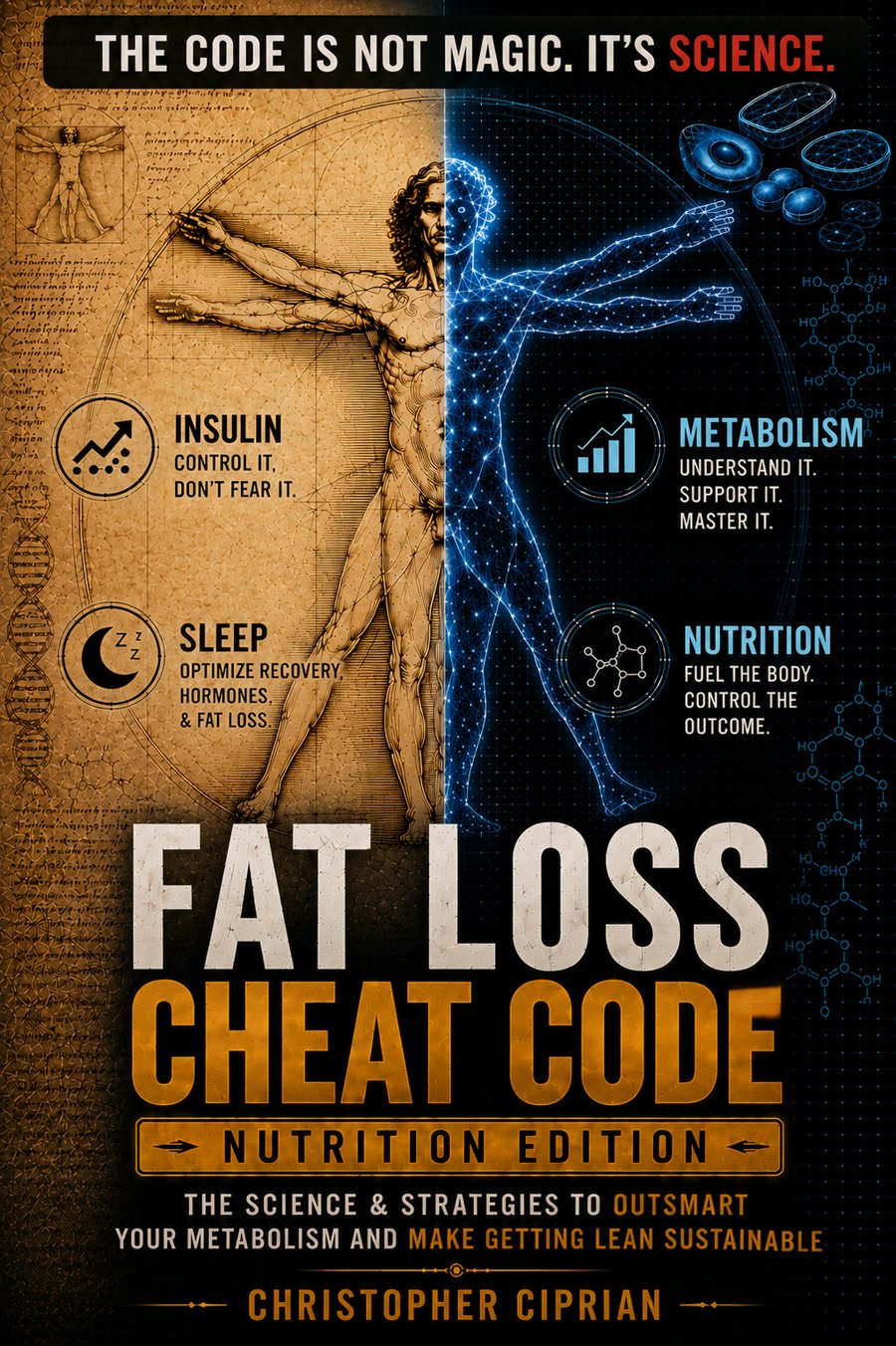
The whole system is in my book, Fat Loss Cheat Code: Nutrition Edition. It’s how you outsmart your metabolism, with every cheat code and the science behind it. Sleep, and the Circadian Cheat Code, are in chapter one.
Buy on AmazonAnd if you want someone to look at your whole picture with you, sleep included, and adjust as you go, that’s what coaching is for.
Sources: Nedeltcheva et al., Annals of Internal Medicine, 2010 (10 overweight adults, 8.5 vs 5.5 hours in bed on the same diet). Spiegel et al., Annals of Internal Medicine, 2004 (12 healthy young men, two nights of 4 hours in bed). Parsons et al., International Journal of Obesity, 2015 (Dunedin study, 815 adults who don’t work shifts).